Lookalike domain monitoring

Know the moment someone registers a domain that looks like yours.

Greyphish checks every new TLS certificate and domain registration for typosquats, homoglyphs and brand-plus-word combinations of your domain, and shows you what each one is doing.

Free for 1 domain, no card needed. Pro is $19 a month.

lookalikes first seen today (UTC)
54
in the last 7 days
3,038
brands in the public feed
1,250

Detected just now

Recent
  1. secure-paypal[.]com
    Matches PayPal · combosquat · CT log
  2. mediun[.]com
    Matches Medium · homoglyph · CT log
  3. chatgptappsbuilders[.]com
    Matches OpenAI · combosquat · CT log
  4. ryan-air[.]com
    Matches Ryanair · combosquat · CT log
  5. nytinmes[.]com
    Matches The New York Times · homoglyph · CT log
  6. mewegg[.]com
    Matches Newegg · homoglyph · CT log
  7. husqvama[.]com
    Matches Husqvarna Group · homoglyph · CT log
  8. myhostgator[.]site
    Matches HostGator · combosquat · CT log
Open the live feed

The problem

Lookalikes are registered every day

Three real lookalikes of well-known brands, first seen in the last 7 days and picked automatically from public data. Resembling a brand is not proof of intent: many lookalikes are parked, defensive or someone else’s legitimate name, which is why every finding comes with evidence.

CombosquatCoinbase

coinbasehelpmgmt[.]com

Registered and resembles Coinbase, built from “coinbase” + “help”.

First seen
Oct 15, 2026, in a Certificate Transparency log
Registered
On Apr 15, 2026, through Cosmotown
Website
Serves a website
Email
Publishes MX records: it can receive email
Blocklist
Listed by Google Web Risk
Hosting
PONYNET
HomoglyphTradingView

xn--tradngview-d0b[.]com

Displays as tradłngview[.]com

Registered and resembles tradingview.com, with a letter swapped for a look-alike character.

First seen
Oct 11, 2026, in a Certificate Transparency log
Registered
On Apr 16, 2026, through NICENIC INTERNATIONAL GROUP
Website
No website when checked
Email
No mail records
Blocklist
Listed by Google Web Risk
Hosting
CLOUDFLARENET
TyposquatAdobe

2adobe[.]com

Registered and resembles adobe.com, with one character inserted.

First seen
Oct 12, 2026, in a Certificate Transparency log
Registered
The same day it was first seen, through Cosmotown
Hosting
HKCICL-AS-AP Hong Kong Communications International Co., Limited

Domains are defanged: [.] stands for a dot. Read more on combosquatting and homoglyph domains.

How it works

Three steps, then it runs on its own

  1. Add your domain

    Greyphish generates the names an impersonator would pick: typos, look-alike characters, your name plus words like login, support or my, and the same name on other TLDs. On day one it lists the ones that are already registered.

  2. Every new certificate and registration is checked

    Certificate Transparency logs are read as certificates are issued. ICANN zone files add newly registered domains once a day, including the ones that never get a certificate.

  3. You get the finding, with evidence

    Each match appears on your dashboard with what we found out about it, and in a daily email digest. On Pro, a webhook fires for every match as it is found.

Each finding

Evidence, not just a list of names

A registered lookalike on its own tells you little. Greyphish checks what it is doing and keeps checking, so the few that matter stand out from the many that never do anything.

  • Live site

    Whether it answers on the web, the page title, and whether the page asks for a password.

  • Mail records

    Published MX records mean the domain can receive email, the setup behind invoice and supplier fraud.

  • Registrar and age

    Who it was registered through and when. A lookalike registered the day it was seen is a different story from one held for ten years.

  • Google Web Risk

    Whether Google’s blocklist already flags it, and when it was listed.

  • TLS server fingerprint

    The JARM fingerprint of its server, grouped with other lookalikes answering the same way, and flagged when it matches a known C2 framework.

  • Certificate siblings

    The other names on the same certificate, which are often the rest of the campaign.

  • Hosting

    IP, network and country, flagged when the address sits on a known-bad netblock such as Spamhaus DROP.

  • Takedown tracking

    When it went live, when it was blocklisted, when it went down, the registrar’s abuse contact, and a Netcraft report you approve before it is sent (Pro).

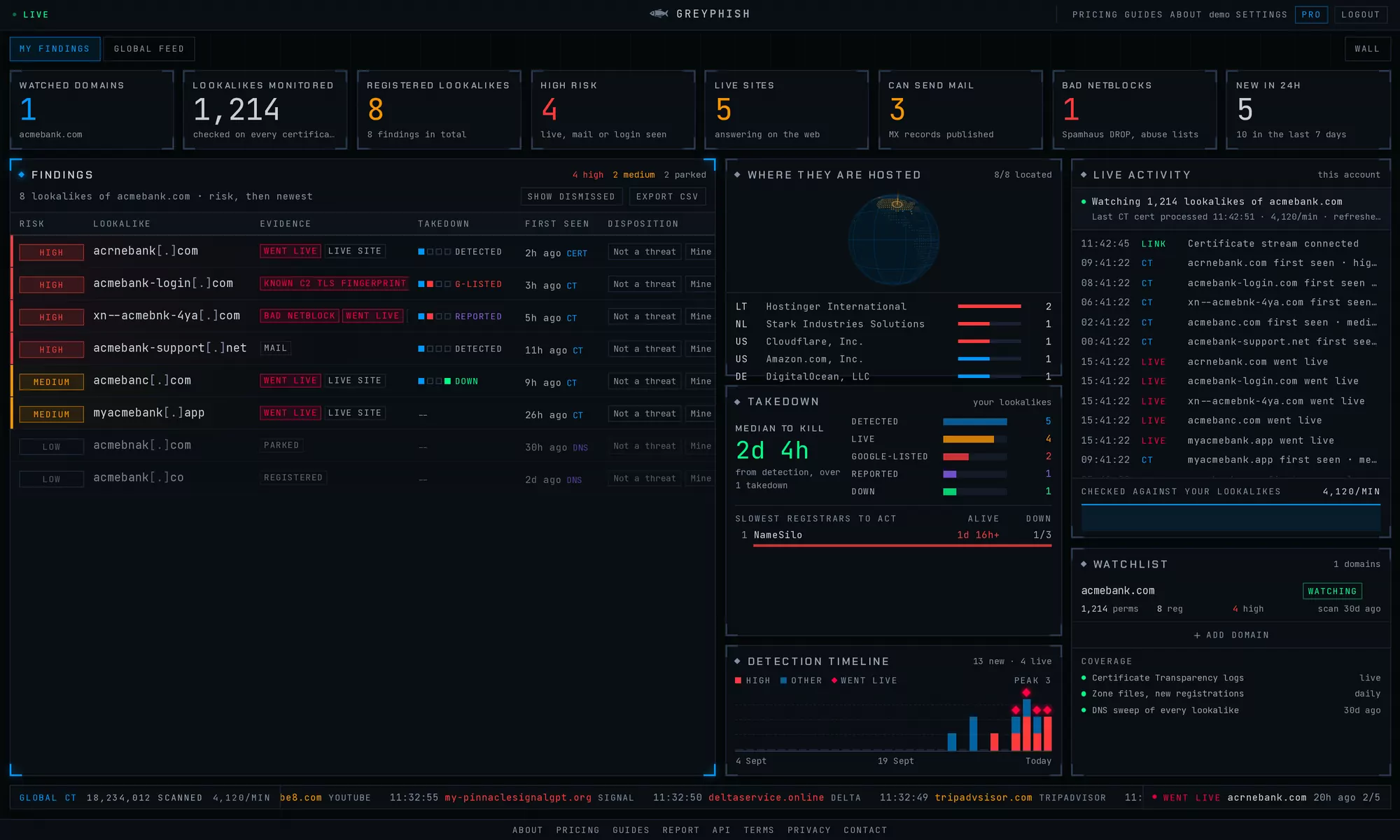
The My findings view: risk counts across the top, the findings table with evidence tags, a hosting globe, takedown progress and a detection timeline.
My findings, on a demo account. Wall mode runs this view full-screen for a SOC display.
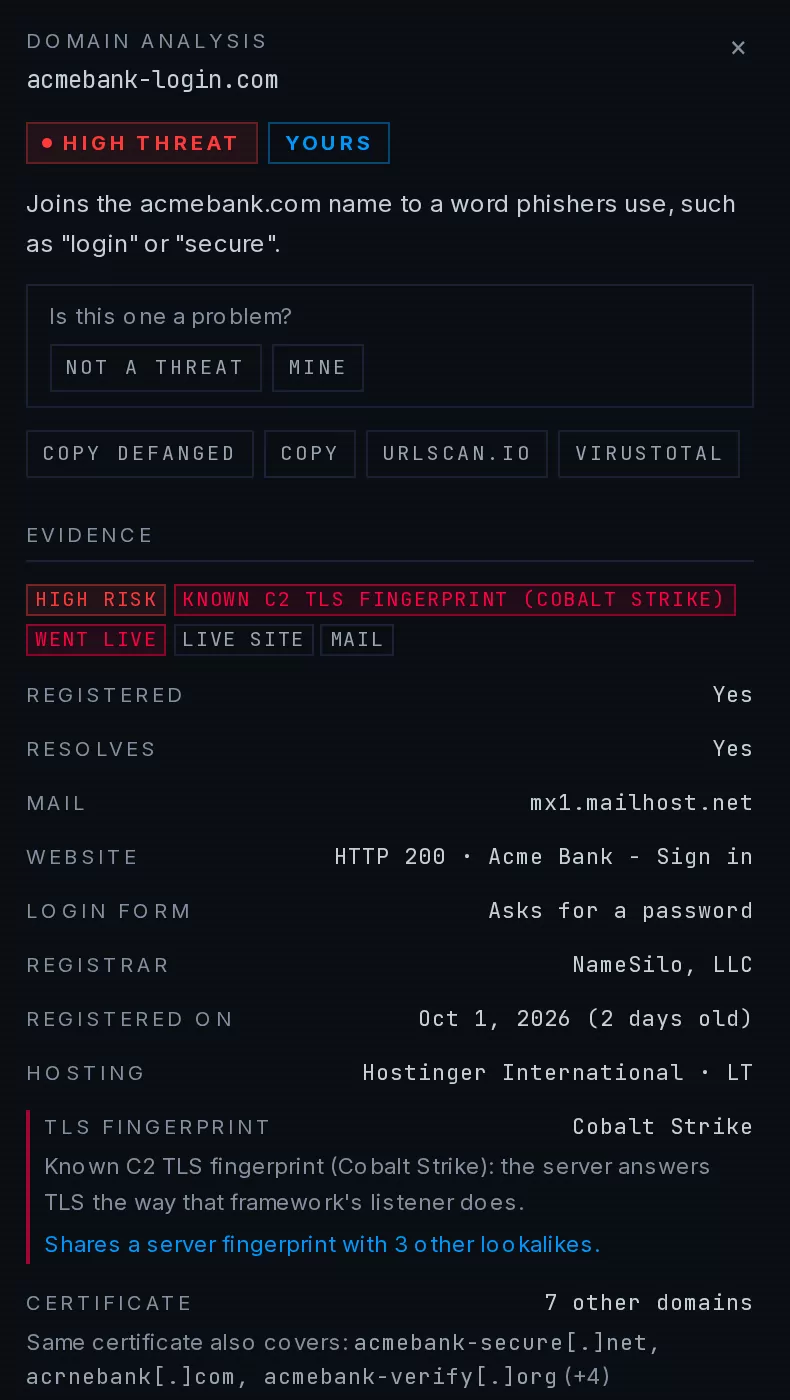
The detail drawer for one finding: website, login form, registrar, hosting, TLS fingerprint, certificate siblings and takedown stages.
One finding, openedThe drawer shows what the lookalike serves, who registered it and when, where it is hosted, which server fingerprint and certificate it shares with other lookalikes, and how far its takedown has got.What to do when you find one

Plans

Free for one domain

Every lookalike finding is on both plans. Pro is for more domains and for sending findings to your own tools.

FeatureFree$0Pro$19/month
Watched domains1Unlimited
Lookalike findingsAllAll
New hosts on your domainFirst 3 per domainAll
Email alertsDaily digestDaily digest
Webhook alerts—Every match
WHOIS on findings—Included
Infrastructure mapCluster sizesDomains, hosts, nameservers
Breach reports—Included
Findings export—TXT, hosts file, CSV
API access—10,000 credits

Questions

Frequently asked

How is this different from running dnstwist or setting up crt.sh alerts?

dnstwist generates the permutations of a domain and checks them when you run it. crt.sh shows certificates that were already issued, if you search for the right names. Greyphish does both continuously: it checks every new certificate as it is logged and every new registration in the daily zone files against your lookalikes, and attaches evidence to each match so a parked domain does not look like one serving a login page.

Will you alert on my own defensive registrations?

At first, possibly: a domain you registered defensively looks exactly like a lookalike. Mark it Mine once and it leaves your dashboard, your exports, your digest and your webhook. A finding that shares your nameservers or registrant organisation, or redirects to your domain, is labelled as probably yours.

Do you take domains down for me?

No. Greyphish tracks each lookalike from first sighting to takedown and shows the registrar’s abuse contact. On Pro you can send a finding to Netcraft, which asks the host and registrar to remove it if it confirms the site is malicious. Nothing is reported until you have seen and approved exactly what will be sent.

What data do you keep?

Your email address, a hashed password, the domains you watch and the findings for them. Watched domains are never shown in the public feed, the weekly report or our social posts. Account data is deleted within 90 days of closing your account, and site analytics store no IP addresses and set no cookies.

Is the free plan really free?

Yes. The free plan covers 1 watched domain, every lookalike finding for it and the daily email digest, with no card required. Pro is $19 a month and adds unlimited domains, webhooks, WHOIS, exports and API access.

How fast are alerts?

A certificate is checked as soon as it is logged and a match appears on your dashboard straight away. Domains that never get a certificate surface from the next daily zone file. Email is a daily digest; on Pro a webhook fires for each match as it is found.

Which kinds of lookalike do you look for?

Typos (dropped, doubled, swapped or replaced characters), homoglyphs including Unicode look-alikes that travel as punycode, your name combined with words such as login, support, secure or my, and your name on other TLDs.

See which lookalikes of your domain already exist

Add your domain and Greyphish lists the registered lookalikes it finds today, then watches every new certificate and registration for more.